GHK-Cu, the "blue copper peptide", is a cult favourite in skincare for firmer-, smoother- and more radiant-looking skin. Here's what it is, how cosmetic formulators use it, and how to mix and store your own serum.
What is GHK-Cu?
Copper tripeptide-1 (INCI; GHK-Cu, CAS 89030-95-5) is a small peptide made of three amino acids (glycine, histidine and lysine) bound to a copper ion. The copper gives the powder its deep blue colour and gives finished serums a pale blue tint. It's water-soluble, so it suits serums and light creams.
How is it used in cosmetics?
Copper peptide serums and creams are used at night for skin that looks smoother, firmer and more even in tone. They're also popular in scalp and hair-care products for a healthier-looking scalp. In leave-on skincare, typical levels are 0.1–2%, and DIY formulators often use 1–3%.
- pH: 5.0–7.0. It can become unstable below about pH 4.5.
- Pairs well with: hyaluronic acid, glycerin, panthenol, squalane, niacinamide (at moderate levels) and other peptides.
- Avoid using at the same time as: L-ascorbic acid (vitamin C), AHA/BHA acids, retinoids and strong chelating ingredients such as EDTA. These can interfere with the copper complex. Use them at a different time of day.
DIY serum: mixing a 30 mL bottle
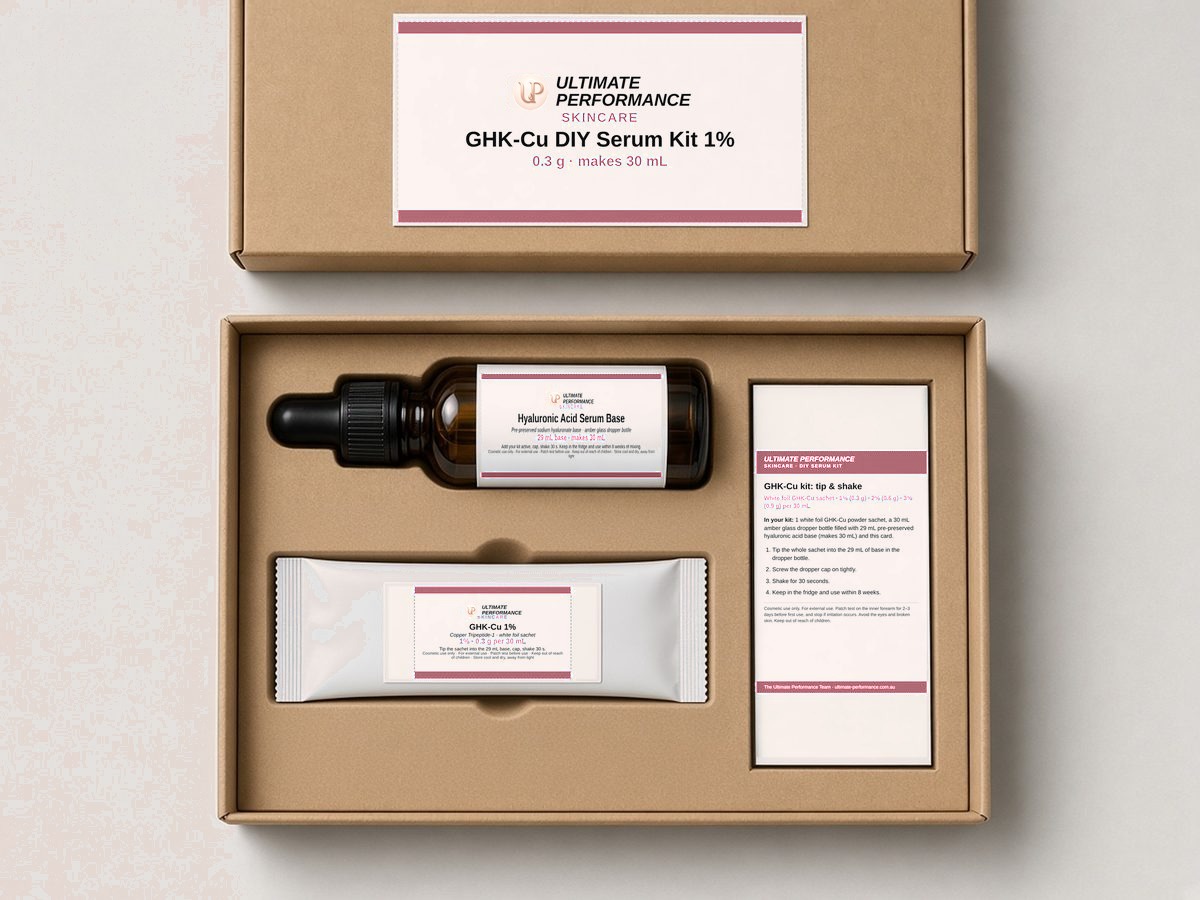
Our GHK-Cu DIY Serum Kits come in 1% (0.3 g), 2% (0.6 g) and 3% (0.9 g) strengths. Each kit has a pre-weighed GHK-Cu powder sachet, a how-to card and one 30 mL amber glass dropper bottle filled with 29 mL pre-preserved hyaluronic acid base (makes 30 mL). Beginners should start at 1%.
- Tip the GHK-Cu sachet into the 29 mL of base in the 30 mL amber glass dropper bottle.
- Cap it and shake for 30 seconds.
- Keep the bottle in the fridge and use within 8 weeks.
A brown or green tint, or cloudiness, usually means the pH is off or the serum has been contaminated. Throw it out and mix a new batch.
Storage
Keep the powder sealed with its desiccant, away from light and in the fridge. Let it warm to room temperature before opening. Use mixed serum within 6–8 weeks and keep it cold in an amber bottle.
Patch testing
Patch test on the inner forearm for 2–3 days, and start with use every other night. A little tingling can happen with higher strengths. If you get persistent redness, itching or flaking, stop using it. Don't use it on broken or irritated skin, and avoid it if you know you're sensitive to copper. If you're pregnant, breastfeeding or have a skin condition, ask a health professional first.
What the evidence says (honest summary)
GHK-Cu has decades of laboratory research behind it, plus a number of small cosmetic studies. In those studies, creams containing copper peptides improved the look of fine lines, firmness and skin clarity over 8–12 weeks, compared with a placebo or baseline. Most human studies are small and many are dated, and results depend heavily on the formula and on daily sun protection. GHK-Cu is a cosmetic ingredient here, and we make no claims beyond how skin looks and feels.
FAQ
Which strength should I choose?
Start with 1%. Move up to 2–3% only if your skin is comfortable after a few weeks.
Can I use it with Argireline, SNAP-8 or Matrixyl?
Yes. A popular routine is GHK-Cu at night and an Argireline, SNAP-8 or Matrixyl serum in the morning, followed by sunscreen.
Why is my serum blue?
That's the copper. A clear, light blue is normal.
Can I use it on my scalp?
Many people do, for a healthier-looking scalp. Patch test first.
Is this for injection?
No. Our GHK-Cu is sold for topical cosmetic use only.
Every peptide we use is independently lab-tested for identity and purity before it goes into our creams and serums. For laboratory research materials, see Ultimate Peps; lab testing is available from QLD Analytical (Queensland, Australia).
For topical cosmetic use only. Not intended to diagnose, treat, cure or prevent any disease. Individual results vary. — The Ultimate Performance Team