Palmitoyl pentapeptide-4, best known by the trade name Matrixyl, is one of the original "signal peptides" in anti-ageing skincare. It's used in serums and moisturisers for smoother, firmer-looking skin, and works well alongside other peptides.
What is palmitoyl pentapeptide-4?
Palmitoyl pentapeptide-4 (INCI; also called Pal-KTTKS, CAS 214047-00-4) is a five-amino-acid peptide with a palmitic acid "tail" attached. The fatty tail helps it blend into skincare formulas and sit well on the skin surface. As a raw material it's a white powder that dissolves better in glycols (such as butylene glycol or propanediol) than in plain water.
Don't confuse it with Matrixyl 3000, which is a different blend of two peptides (palmitoyl tripeptide-1 and palmitoyl tetrapeptide-7). Retail "Matrixyl 3–8%" products also refer to a dilute trade solution of about 100 ppm peptide. So the pure peptide in those products is only a few parts per million.
How is it used in cosmetics?
Pal-KTTKS goes into leave-on serums, eye creams and night creams that aim to make skin look smoother, firmer and more even. It's a "collagen-support" style peptide, unlike the expression-line peptides (Argireline and SNAP-8). That's why many routines use both kinds.
- Typical use level: about 3–50 ppm (0.0003–0.005%) pure peptide.
- pH: 5.0–7.0.
- Pairs well with: hyaluronic acid, niacinamide, ceramides, Argireline, SNAP-8 and GHK-Cu.
- Use at a different time from: strong exfoliating acids and high-strength vitamin C at low pH.
DIY serum: mixing a 30 mL bottle
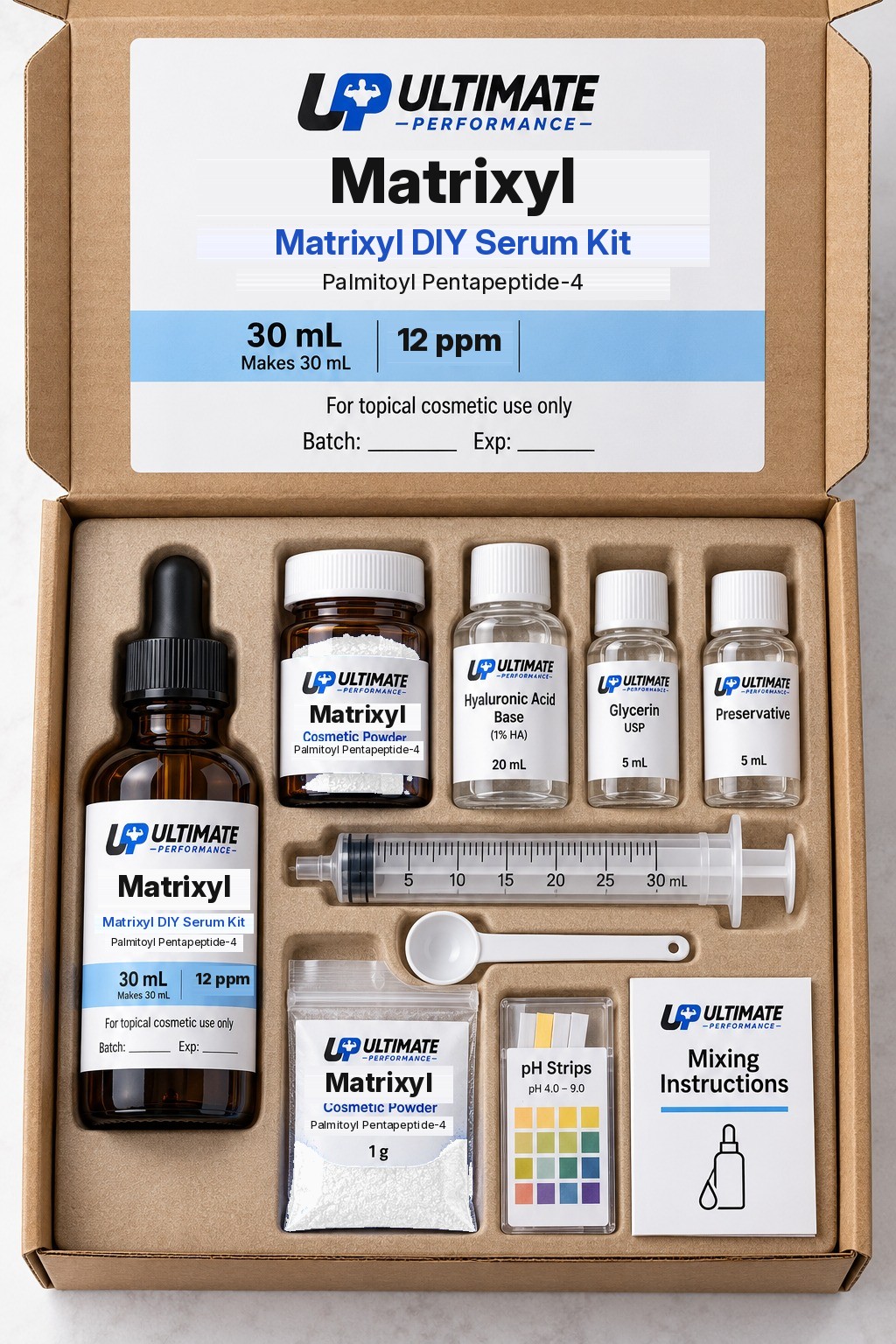
Because you need such a tiny amount (about 1 mg per 30 mL), our Matrixyl DIY Serum Kit includes a 1 mL concentrate in a 10 mL amber glass vial (1 mg peptide) rather than loose powder, plus two 15 mL amber jars of hyaluronic acid base (20 mL in total), 5 mL glycerin, 0.5 mL preservative, an empty 30 mL amber glass dropper bottle with pipette, a 5 mL syringe, pH strips and a how-to card (makes 30 mL). Customers who buy loose powder should make a stock solution first. For example, dissolve 10 mg in 10 mL of butylene glycol and use 1 mL per 30 mL of serum.
- Wash hands. Wipe the bench, bottle and syringe with 70% isopropyl alcohol and let air-dry.
- Empty the 1 mL concentrate vial into the 30 mL dropper bottle (draw it up with the syringe and rinse the vial with a little HA base).
- Add the 5 mL glycerin and swirl for 30 seconds.
- Add the 20 mL hyaluronic acid base with the syringe. Cap and roll gently for 1–2 minutes until clear. Do not shake hard.
- Add the 0.3 mL preservative (1%) and roll again.
- Check pH with a strip: aim for 5.0–6.5. Write the date made on the bottle label.
- Keep the bottle in the fridge and use within 8 weeks.
Storage
Keep the powder sealed, dry and in the fridge (or the freezer for long-term storage), and let it reach room temperature before opening. Keep stock solutions and mixed serums in the fridge and use them within about 8 weeks. Throw out anything that changes in look or smell.
Patch testing
Apply a little to the inner forearm once a day for 2–3 days before facial use. Stop if you get redness or itching. Avoid broken or irritated skin and the eyes. If you're pregnant, breastfeeding or managing a skin condition, ask a health professional before use.
What the evidence says (honest summary)
Palmitoyl pentapeptide-4 is among the better-studied cosmetic peptides. Several small controlled studies, including split-face trials, reported a smoother-looking surface and less visible fine lines after about 8–12 weeks of twice-daily use, compared with a placebo. The improvements were modest and measured as changes in appearance. Many studies were industry-funded, and results vary with the formula and with daily sunscreen use. It's a cosmetic ingredient, and we make no claims beyond how skin looks and feels.
FAQ
Why is the amount so small?
It's used at very low levels, measured in parts per million. A gram of pure powder can make hundreds of bottles.
Can I add it to my moisturiser?
Yes, if you can measure it accurately. Add the glycol stock solution at 1 mL per 30 g of cream and mix well. Ready-made creams may already contain a preservative, but adding anything can change how stable the cream is.
Is it the same as retinol?
No. It's a peptide, not a vitamin A derivative, and it's generally better tolerated by sensitive skin.
Can I use it with GHK-Cu?
Yes. Many routines use GHK-Cu at night and Matrixyl in the morning.
Is it for injection?
No. It's for topical cosmetic use only.
Every peptide we use is independently lab-tested for identity and purity before it goes into our creams and serums. For laboratory research materials, see Ultimate Peps; lab testing is available from QLD Analytical (Queensland, Australia).
For topical cosmetic use only. Not intended to diagnose, treat, cure or prevent any disease. Individual results vary. Matrixyl is a trademark of its respective owner; Ultimate Performance is not affiliated with it. — The Ultimate Performance Team